



The 5 Things That Harm Marriage the Most


Personal Reflections on Marriage
I’ve just finished reading a book called Get Married by University of Virginia sociologist – and lead researcher on The National Marriage Project – Professor Brad Wilcox.
It’s funny. I feel uncomfortable telling people to get married. I feel like it’s so personal. And I’m also a believer in the fact that all families can function well regardless of their structure. It was drummed into me at University that family function trumps family structure.
Reading Get Married has reinforced something to me. My marriage is the single greatest thing in my life. And it’s contributed to more joy and meaning and growth than anything else. Period.
What the Research Says
I am now devouring a book called The Two-Parent Privilege. And again, I’m finding myself thinking that, because of the sensitive nature of relationships, we’re not doing enough to make the case for strong marriages and families.
The Benefits of a Strong Marriage
Here’s the thing. The research on marriage is convincing.
1/ Marriage and Adult Happiness
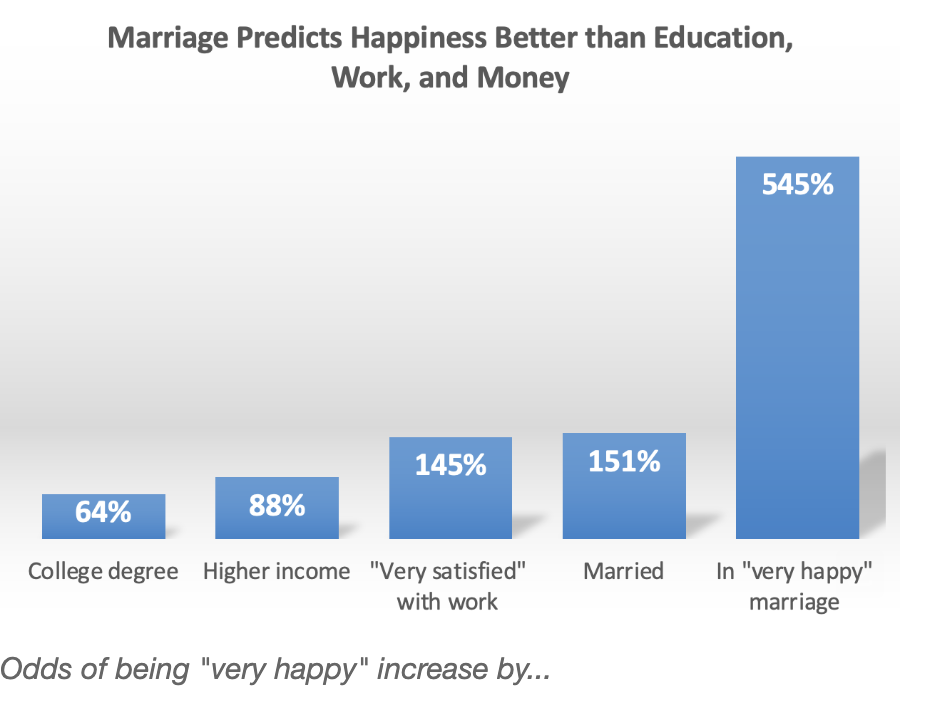
Nothing predicts happiness for adults better than a good marriage.
2/ Impact on Children’s Outcomes
Children raised in homes where parents are married are more likely to go to university, stay off drugs, be financially stable, and generally stay out of trouble.

3/ Financial Advantages of Marriage
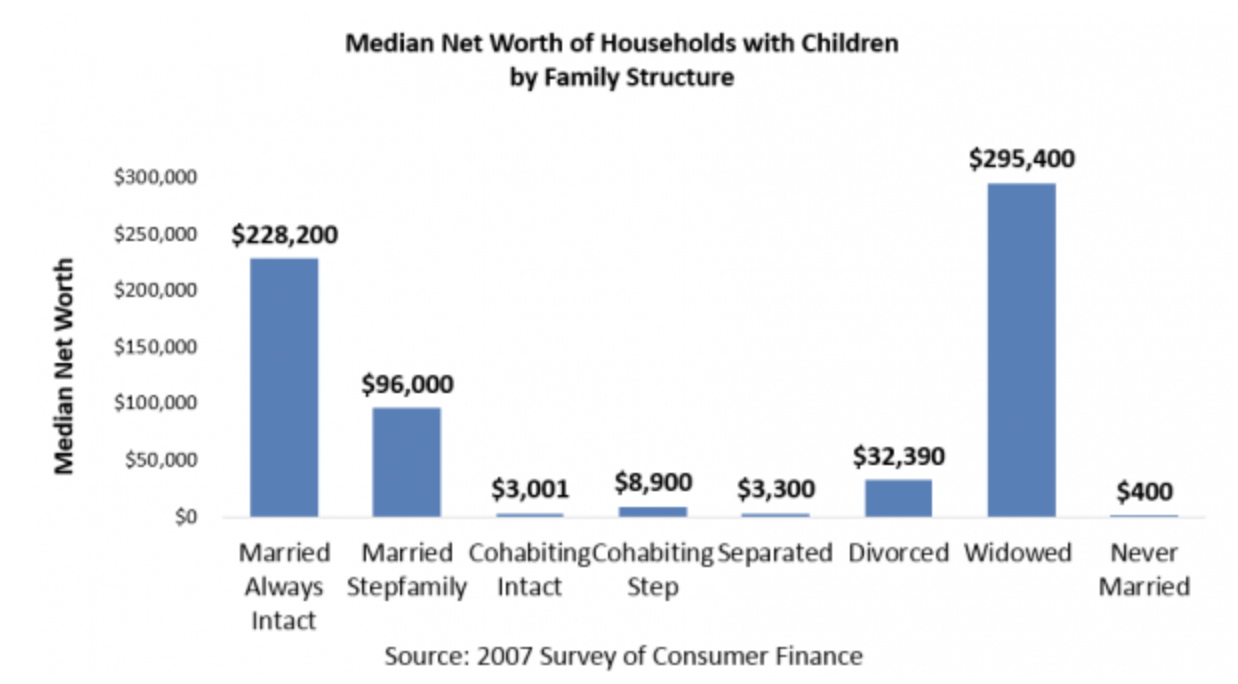
People who are married tend to enjoy enormous financial benefits. Wilcox points out that men earn about 27% more when they’re married than when they’re unmarried. Net worth of both individuals is higher. They accumulate more assets. And they retire wealthier than their unmarried peers.
The Decline of Marriage and Its Social Implications
Few people want to discuss this elephant in the room.
To be clear, in saying this, I’m sensitive to the fact that marriage rates are declining. Fewer people are tying the knot, believing it’s “just a piece of paper”. (Evidence points to it being something quite a lot more than that though.) And I’m aware that there are many people who come from families that have alternative structures who thrive (as well as many people who are married and miserable). But that doesn’t mean we should stop talking about the gold standard, particularly when cold hard data points out that it’s so much better for us as adults and for our kids – and for society!
The Argument for Prioritising Marriage
This argument is not about blaming or diminishing or judging those who are unmarried. It’s a simple recognition that all of the data points to marriage as being profoundly impactful in the most positive ways for everyone, so long as it’s a healthy marriage.
The largest research projects consistently show that marriage is fundamental to well-being and a life well lived.
At the time of writing this, Kylie and I are about to celebrate our 26th wedding anniversary. And I’m (from now on) an unapologetic proponent of getting married and then working out how to stay married. I thought it might be helpful to put together a list of the 5 things that weaken our marriages so we can avoid them as much as possible.
5 Things That Weaken Marriages
1/ The “Me-First” Mindset
In marriage, we often try to manage our spouse and mold them into our perfect version of ourselves. We think we’re awesome and if our spouse could just see the world more like us, they’d be awesome too. Rather than understanding their hopes and dreams and goals – or just their needs for the next 5 minutes – and calibrating our actions to support them, we get caught up in our views, perspectives, needs, and preferences.
Failing to consider the other person acts like kryptonite in a marriage. When husbands feel entitled to a clean house, dinner on the table every night, and intimacy ‘as needed,’ they almost certainly foster resentment and undermine their relationship. It goes the other way too. Endlessly pursuing a goal at the expense of a relationship can rupture the relationship.
Regardless of which scenario it is, selfishness subsumes any goodwill eventually, raises resentment, and crushes the companionship.
2/ The “Maybe I Do” Mindset
Questioning commitment creates conditions that develop into a “maybe I do” approach to marriage. Some research suggests that we are increasingly uncommitted to being committed. Commitment to our marital covenant and to our spouse is highly correlated with trust: the more commitment, the more trust, and vice versa. The corollary is also true. Reduced commitment equals reduced trust.
3/ Expecting a “Soul-mate” Marriage
A study in California shows that a connection exists between the soulmate model and risk for unstable marriages. Wilcox (author of Get Married) quotes from the survey:
Of those who have serious doubts that their marriage will last, 35% think marriage is “mostly about an intense emotion/romantic connection.” Only 25% of those with serious doubts chose that marriage is “about romance but also about kids, money, and raising a family together.”
He concludes that “in contrast [to the soulmate model], folks who are embracing…a family-first model of marriage are more likely to have a stable sense of their future.” A family-first marriage acknowledges that it’s about romance/communion, but also about children, commitment, cash, and community.
4/ Failure to Connect
Life’s busy. Priorities compete. Technology interferes. Exhaustion overcomes. Sex quality declines. We stop putting in effort, and date nights disappear. Best-intentioned efforts fail because kids, work, and running the house get in the way. Even the best efforts can fail when kids, work, and household responsibilities interfere. And we stop seeing, hearing, and valuing one another.
5/ Being Around Others Who Don’t Value Marriage
Show me your friends, and I’ll show you your future. Sounds harsh? Individuals with immediate friends who divorce are significantly more likely to experience divorce themselves. For instance, Rosenquist et al. (2010) * found that the likelihood of divorce increased by 75% for individuals with a divorced friend. Furthermore, McPherson et al. (2001) noted that this effect extends to friends-of-friends, with individuals one degree of separation removed from a divorcee experiencing a 33% higher chance of divorce. This shows a ripple effect, where divorce in close social circles can influence the attitudes and behaviours of friends and acquaintances.
Let’s cut through the noise: marriage matters.
Beyond the Fairytale: Real-World Benefits of Marriage
It’s not just about “happily ever after” fantasies; it’s about real-world benefits. From financial security to better outcomes for kids, the data speaks for itself. Sure, it’s not for everyone, and there are good reasons for some people to not be married. But marriage isn’t about a piece of paper; it’s a foundation for a life of meaning, joy, and growth.
Supporting and Celebrating Healthy Marriages
So, let’s champion marriage, celebrate its merits, and support those who choose this path. It’s time to prioritise the gold standard and reap the rewards.
* Note. This study explores the social network determinants of depression, but it is notable for its examination of social contagion effects, which includes the contagion effect of divorce. See also McPherson, M., Smith-Lovin, L., & Cook, J. M. (2001). Birds of a feather: Homophily in social networks. Annual review of sociology, 27(1), 415-444.


Responses